Search.....

Custom Search
Showing posts with label Jet Fighter. Show all posts

EA-18G Growler Electronic Attack Aircraft

EA-18G Growler Electronic Attack Aircraft
The EA-18G Growler is an airborne electronic attack (AEA) aircraft that operates from either an aircraft carrier or from land-bases. The Growler has been developed as a replacement for the US Navy EA-6B Prowler aircraft which entered service in 1971 and is approaching the end of operational life.

The E/A-18G is the fourth major variant of the F/A-18 family of aircraft. The EA-18G have the capability to operate autonomously or as a significant node in a network-centric operation and will give accurate emitter targeting for employment of onboard suppression weapons like|like the High-Speed Anti-Radiation Missile (HARM).

The EA-18 can perform full-spectrum electronic surveillance and electronic attack of enemy threat radars and communications nets. The EA-18 leverages the U.S. Navy's investment in the F/A-18E/F Super Hornet platform. the EA-18 is highly versatile design that allows the warfighter to perform a broad range of tactical missions.

Continue Reading of EA-18G Growler Electronic Attack Aircraft...

F-15SE Silent Eagle Stealth Fighter Jet

F-15SE Silent Eagle Stealth Fighter Jet
F-15SE Silent Eagle Stealth Fighter JetThe F-15SE Silent Eagle is a stealth fighter jet that's being developed by the Boeing Company. The F-15SE is being designed and built for the U.S. Air Force as a potential upgrade of the F-15E fighter jet. the original first F-15 Eagle is a well known tactical fighter jet that first entered service with the U.S. military in 1976 and had a storied combat career.

The F-15SE is an advanced version of the stalwart fighter jet, and boasts many distinctive features like stealth capabilities, a high-tech electronic warfare system, radar-absorbent materials, and an internal weapons carriage. The aircraft is also lighter and more fuel efficient than previous versions of the F-15 fighter jet.

The F-15SE Silent Eagle can travel at supersonic speeds, with a most speed of Mach 2.5 – about 1,650 miles per hour. The plane generally has a crew of two people however its can be flown with only one person. In terms of weapons, the F-15SE is armed with an M61 Vulcan Gatling gun that has 510 rounds of ammunition, and internal and external hard points that enable to hold a variety of missiles. The aircraft also has an advanced electro-optical targeting system and Infrared tracking system

Continue Reading of F-15SE Silent Eagle Stealth Fighter Jet...

F-15E Strike Eagle Dual-Role Fighter

F-15E Strike Eagle Dual-Role Fighter
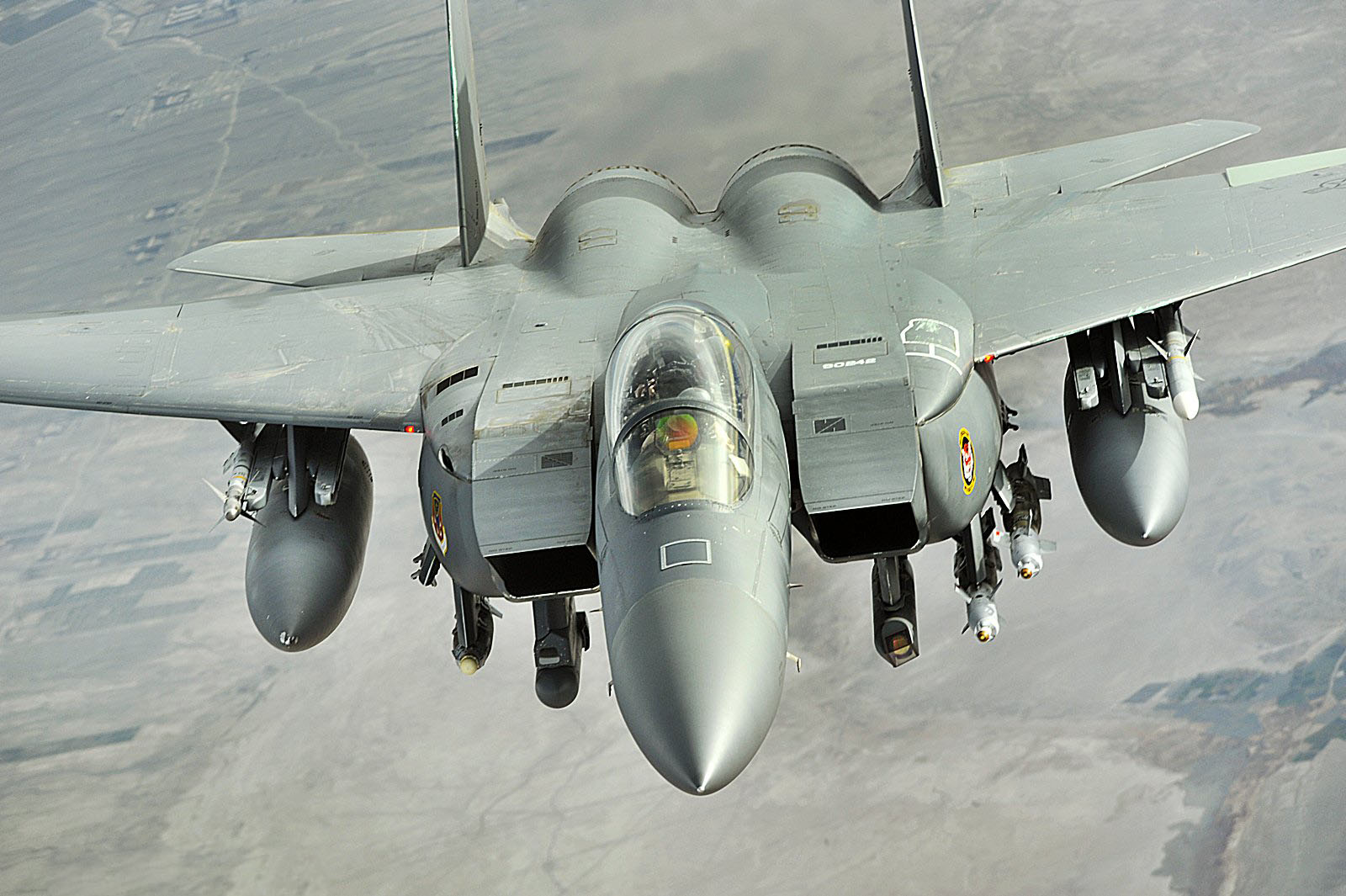
The Boeing F-15E dual-role fighter is an advanced long-range interdiction fighter and tactical aircraft. The F-15E is the latest version of the Eagle, a Mach 2.5-class twin-engine fighter. over 1,500 F-15s are in service worldwide with the US Air Force, US Air National Guard and also the air forces of Israel, Japan and Saudi Arabia, including over 220 F-15E fighters.

The mission of the Strike Eagle is as succinct as that of its air-to-air cousin: to put bombs on target. while previous models of the Eagle are assigned air-to-air roles, the "E" model is a dual-role fighter. it's has the capability to fight its way to a target over long ranges, destroy enemy ground positions, and fight its way back out.

The F-15E performs day and night all weather air-to-air and air-to-ground missions as well as strategic strike, interdiction, OCA and DCA. although primarily a deep interdiction platform, the F-15E also can perform CAS and Escort missions. The F-15E is especially configured for the deep strike mission, venturing far behind enemy lines to attack high value targets with a spread of munitions.

Advanced avionics systems give the F-15E the capability to fight at low altitude, day or night, and in bad weather. An inertial navigation system, developed by Honeywell, uses a laser gyro to continuously monitor the aircraft's position and provide information to the central computer and other systems, including a digital moving map in both cockpits.

Continue Reading of F-15E Strike Eagle Dual-Role Fighter...

F/A-18E/F Super Hornet Naval Strike Fighter

F/A-18E/F Super Hornet Naval Strike Fighter
F/A-18E/F Super Hornet Naval Strike FighterThe F/A-18 E/F Super Hornet naval strike fighter aircraft, manufactured by Boeing, flew for the first time on November 29 1995. The Super Hornet is 25th larger than its predecessor, the F/A-18C/D, however contains 42nd fewer structural components. The single-seat F/A-18/E and also the two-seat F/A-18/F fly larger ranges with heavier payloads, have a lot of powerful engines and provide greater survivability.

The Super Hornet can carry approximately 17,750 pounds (8,032 kg) of external load on eleven stations. it's an all-weather air-to-air radar and a control system for correct delivery of standard or guided weapons. There are two wing tip stations, four inboard wing stations for fuel tanks or air-to-ground weapons, two nacelle fuselage stations for Sparrows or sensor pods, and one centerline station for fuel or air-to-ground weapons. an internal 20 mm M61A1 Vulcan cannon is mounted within the nose.

The Hughes Advanced Targeting Forward-Looking Infra-Red (ATFLIR), the baseline infrared system for the F/A-18 E/F, also will be deployed on earlier model F/A-18s. The Hughes pod{features each navigation and infrared targeting systems, incorporating third generation mid-wave infrared (MWIR) staring focal plane technology.

Continue Reading of F/A-18E/F Super Hornet Naval Strike Fighter...

YF-23 Black Widow Tactical Fighter Prototypes

YF-23 Black Widow Tactical Fighter Prototypes
Two YF-23 prototypes designed by the contractor team of Northrop and McDonnell Douglas as a part of the demonstration and analysis phase|part of the US Air Force's Advanced Tactical Fighter selection program, that concluded in 1990. consistent with the Air Force, factors in the selection for production of the F-22 were a much better designed for maintainability, larger potential for future development, and slightly lower value. a popular view is that the decision mirrored a preference for maneuverability over stealth, and it's universally held that the YF-23 was by far the better looking aircraft.

During the ATF program, one YF-23 was powered by twin Pratt and Whitney YF119 turbofan engines, while 2 General electrical YF120 turbofan engines were put in different prototype. that includes a diamond-shaped planform, two large, sharply-canted ruddervators, and a serrated aft profile, the high performance aircraft was larger than the F-15 it was designed to exchange. The YF-23 used stealth characteristics and was capable of supersonic cruise flight without afterburner.

Continue Reading of YF-23 Black Widow Tactical Fighter Prototypes...

F-35 Lightning II Joint Strike Fighter

F-35 Lightning II Joint Strike Fighter
The F-35 Lightning II joint strike fighter (JSF), is being developed by Lockheed Martin Aeronautics Company for the US Air Force, Navy and Marine Corps and UK Royal Navy.

JSF is a joint, multinational acquisition program for the Air Force, Navy, Marine Corps, and eight cooperative international partners. Expected to be the biggest military aircraft procurement ever, the stealth, supersonic F-35 Joint Strike Fighter (F-35) will replace a large range of aging fighter and strike aircraft for the U.S. Air Force, Navy, Marine Corps and allied defense forces worldwide.

The JSF aircraft design has 3 variants: standard takeoff and landing variant for the Air Force, aircraft carrier-suitable variant for the Navy, and short takeoff and vertical landing variant for the Marine Corps, the UK, and the Air Force. These aircraft are supposed to switch aging fighter and attack aircraft currently in the inventory.

The Air Force's F-35A version of the craft is a standard takeoff and landing airplane to exchange the F-16 Falcon and A-10 Thunderbolt II. it'll partner with the F-22 Raptor. The Marine Corps, Royal Navy and Royal Air Force need and want a short takeoff and vertical landing aircraft, dubbed the F-35B. The Marines want new aircraft to exchange their AV-8B Harriers and F/A-18 Hornets. The British need to switch sea Harriers and GR.7 Tornado fighters. The Navy's F-35C version of the plane is a carrier-based strike fighter to complement the F/A-18E/F Super Hornet. it'll replace earlier versions of the F/A-18 yet as the A-6 Intruder, that already has left the inventory.

Continue Reading of F-35 Lightning II Joint Strike Fighter...

F-22 Raptor Advanced Fighter Aircraft

F-22 Raptor Advanced Fighter Aircraft
The F-22 Code Name Raptor is an air dominance fighter with much-improved capability over current Air Force aircraft. it's widely considered as the most advanced fighter in the world, combining a revolutionary leap in technology and capability with reduced support requirements and maintenance prices. it'll replace the F-15 as America's front-line, air superiority fighter, with deliveries to operational units in 2005.

The F-22 program is developing the next-generation air superiority fighter for the US Air Force to counter rising worldwide threats. The F-22 Raptor is intended to make sure that America's military force retain air dominance. this means complete {control of the airspace over a section of conflict, thereby permitting freedom to attack and freedom from attack at all times and places for the complete spectrum of military operations. Air dominance provides the power to defend our forces from enemy attack and to attack adversary forces without hindrance from enemy aircraft.

The F-22's combination of stealth, integrated avionics, maneuverability and supercruise will can offer Raptor pilots a first-look, first-shot, first-kill capability against the aircraft of any potential enemy. The F-22 is intended to provide not just air superiority, however air dominance, winning quickly and decisively with few US casualties. The Raptor also has an inherent air-to-ground capability.

Continue Reading of F-22 Raptor Advanced Fighter Aircraft...

F/A-18 Hornet Multi-mission Attack Aircraft

F/A-18 Hornet Multi-mission Attack AircraftF/A-18 Hornet Multi-mission Attack AircraftThe F/A-18 "Hornet" is a single- and two-seat, twin engine, multi-mission fighter/attack aircraft and can operate from either aircraft carriers or land bases. The F/A-18 fills a variety of roles: air superiority, fighter escort, suppression of enemy air defenses, reconnaissance, forward air control, close and deep air support, and day and night strike missions. The F/A-18 Hornet replaced the F-4 Phantom II fighter and A-7 Corsair II light-weight attack jet, and also replaced the A-6 Intruder as these aircraft were retired throughout the 1990s.

The F/A-18 is in service with the U.S. Navy, U.S. Marine Corps and air forces of Canada, Australia, Spain, Kuwait, Finland, Switzerland, and Malaysia. As of may 1999 Hornet pilots had accumulated over 3.7 million flight hours and, in the process, are establishing new records daily in safety, reliability, maintainability and mission performance.

The Hornet was designed to be reliable and simply maintainable. These factors lead to considerably lower operating and maintenance costs for the F/A-18 compared to other U.S. Navy fighter and attack aircraft; and life cycle costs comparable to other modern multi-role aircraft. Survivability is another key feature of the Hornet. The F/A-18 uses a variety of systems and technologies to extend its probability of reaching a target undetected, of escaping unhurt if detected, and of returning its crew safely if it's hit.

Continue Reading of F/A-18 Hornet Multi-mission Attack Aircraft...

F-16 Fighting Falcon Multi-role Fighter Aircraft

F-16 Fighting Falcon Multi-role Fighter Aircraft
The Lockheed Martin F-16 Fighting Falcon, the first of the US Air Force multi-role fighter aircraft, is the most prolific fighter in world with over 2,000 in service with the USAF and 2,000 operational with 25 other countries.

In an air combat role, the F-16's maneuverability and combat radius (distance it can fly to enter air combat, stay, fight and return) exceed that of all potential threat fighter aircraft. It can find targets in all weather conditions and detect low flying aircraft in radar ground clutter. In an air-to-surface role, the F-16 can fly over 500 miles (860 kilometers), deliver its weapons with superior accuracy, defend itself against enemy aircraft, and come back to its starting point. An all-weather capability permits it to accurately deliver ordnance throughout non-visual bombing conditions.

Continue Reading of F-16 Fighting Falcon Multi-role Fighter Aircraft...

F-15 Eagle All-Weather Jet Fighter

F-15 Eagle All-Weather Jet Fighter
The F-15 Eagle is an all-weather, maneuverable, tactical jet fighter designed and maintain air superiority in aerial combat. The Eagle's air superiority is achieved through of maneuverability and acceleration, range, weapons and avionics. The F-15 has electronic systems and weaponry to detect, acquire, track and attack enemy aircraft operating in friendly or enemy-controlled airspace. Its weapons and flight systems are designed one person safely and effectively perform air-to-air combat. It penetrate enemy defense and outperform and outfight current or projected enemy aircraft.

The F-15 Fighter single-seat or two-seat, supersonic, long~range, all-weather air superiority fighter by the McDonnell Douglas Aircraft Corporation. The F-15 Fighter was in fighter airplane technology. The F-15 Fighter is powered by Pratt & Whitney F100-PW-100 turbofan engines with variable afterburning thrust. The airplane shoulder-mounted swept wing with twin horizontal ramp inlets and twin vertical stabilizers. The wing, was designed primarily for transonic maneuverability, has no active maneuver enhancement devices.

Continue Reading of F-15 Eagle All-Weather Jet Fighter...

F-14 Tomcat Multi-Mission Fighter Aircraft

F-14 Tomcat Multi-Mission Fighter AircraftF-14 Tomcat Multi-Mission Fighter Aircraft

The Grumman F-14 Tomcat is a multi-mission fighter aircraft. Originally designed as an air superiority fighter to overcome any potential threat to the battle group, has taken many other important missions today as ground attack (including laser-guided bombs) and tactical reconnaissance.

In the air superiority role the F-14 has a weapon like no other: the AIM-54 Phoenix missile with a range of access of 100 miles. Six of these missiles can be fired air targets and focus on cruise missiles or enemy bombers input independently. Other air-air weapons are the AIM-9 Sidewinder heat Seaking standard short range missile, the AIM-7 Sparrow medium-range missile, the AIM-120 AMRAAM (advanced medium range air to air missile) and of course the M61A Vulcan cannon 6000 rounds per minute.

The capacity of air-land was not long trained in the F-14 community. Although the original 1970 design includes air-ground capability, only in recent years, the F-14 was again a fighter-bomber. Not only iron bombs and cluster bombs can be delivered, but also the latest laser-guided munitions. In doing so, the F-14 can also identify and mark their own objectives with the LANTIRN (low altitude navigation and targeting infrared night) of the sheath. So even after more than 25 years of service with the U.S. Navy the F-14 Tomcat is - despite the aging - a more capable fighter.

Continue Reading of F-14 Tomcat Multi-Mission Fighter Aircraft...